ServicesReverse Osmosis
Reverse Osmosis Systems in Dunedin, FL
We install under-sink reverse osmosis units that feed a separate faucet beside your main tap, so the water you drink and cook with is filtered most finely. You get an arrival window you can plan around, a clean cabinet when we pack up, and a clear note of when each filter is due.
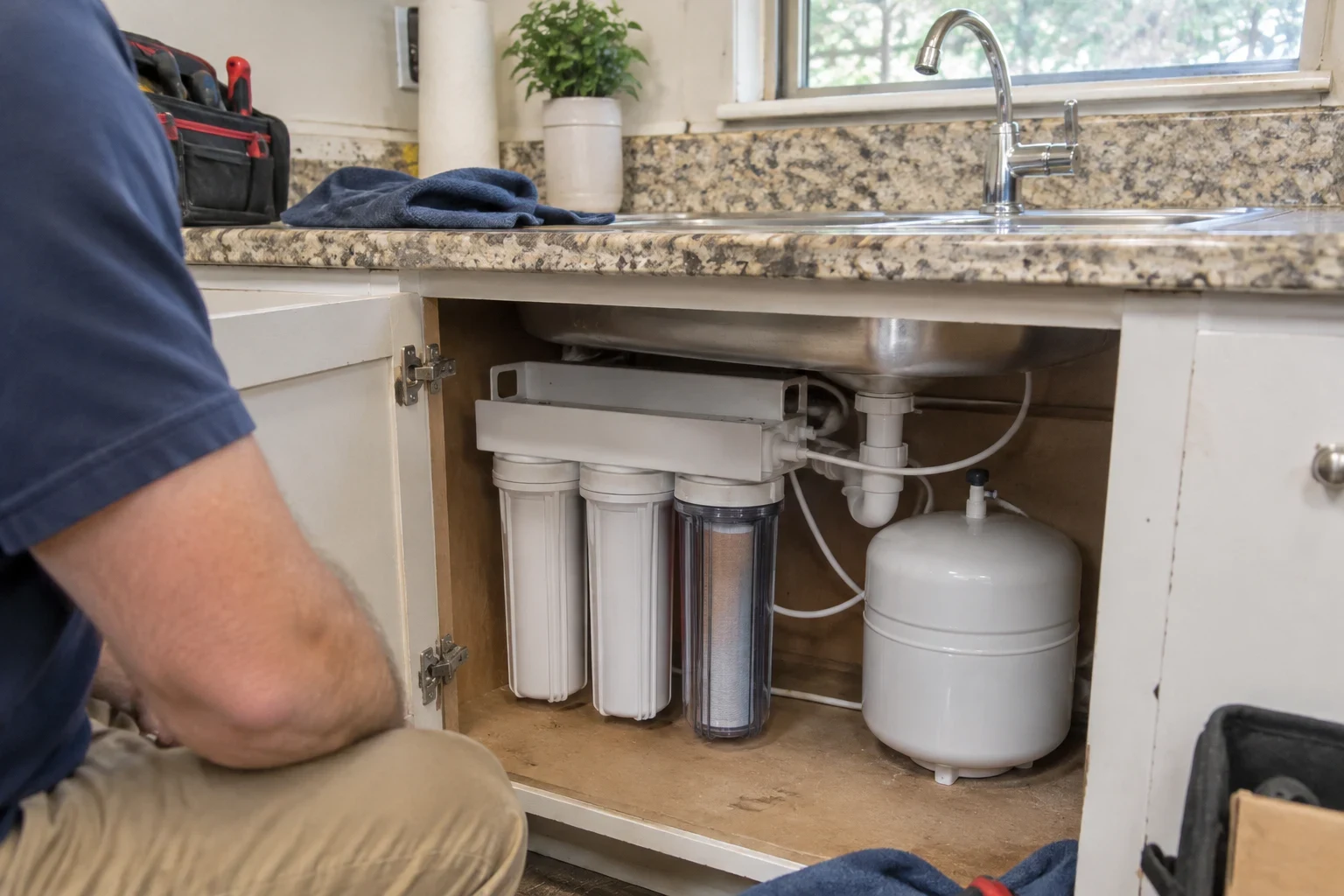
What a reverse osmosis system does for your kitchen
Inside a reverse osmosis unit, household pressure drives water across a membrane so fine that most dissolved material cannot pass through it. Whatever the membrane holds back is rinsed to the drain, and the purified water waits in a compact tank under the counter. The process reduces lead picked up from older pipes and solder inside a house, lowers many other dissolved contaminants, and removes the chlorine note that tends to come through in coffee and ice.
The system serves one faucet, so it covers drinking and cooking water and leaves showers, laundry and toilets on your regular supply. That scope suits a lot of households well. If you want treated water at every tap, our whole-home filtration and chlorine and chloramine removal pages describe those systems, and either one pairs comfortably with an RO unit in the kitchen.
What the installation includes
- Sediment and carbon prefilters
- These early stages trap grit and rust flakes and take out chlorine first. Chlorine breaks down membrane material over time, so stopping it upstream helps the membrane last.
- Membrane housing and storage tank
- We position the membrane and the pressurized tank so you can reach every cartridge without unloading the whole cabinet. The tank's air charge is checked and set before it fills.
- A separate faucet for filtered water
- Where your sink already has a spare opening, such as an unused sprayer or soap dispenser hole, we put it to use. If a new opening is needed, we cut it with a bit matched to your countertop and seal the edge.
- Drain line with an air gap
- Waste water leaves through a saddle clamp on the sink drain pipe, arranged so nothing can draw back toward the filters.
- Refrigerator or ice maker connection
- On request, we run tubing from the unit to your fridge, so chilled water and ice come from the same treated supply as your faucet.
- Flush, pressure check and walkthrough
- Fresh cartridges are flushed, each fitting is inspected while the system holds pressure, and we point out the shutoff valve and how a filter swap works.
Signs reverse osmosis fits your home
You buy cases of bottled water
When hauling bottled water home is part of every week, a filtered faucet tends to end that chore and gives you back shelf space.
Coffee, tea or ice tastes off
A chlorine edge or a dull mineral flavor is most noticeable in a hot cup or a glass with ice. The carbon cartridges ahead of the membrane take care of that taste.
Your plumbing is older
Lead often comes from aging pipes and solder within the house, not from the water arriving at the meter. Reverse osmosis ranks among the more reliable ways to lower it at the faucet you drink from.
Pitcher filters are not keeping up
Waiting on a pitcher to drip through, and buying cartridges again and again, wears thin in a busy kitchen. An RO tank has filtered water ready whenever you open the tap.
An older RO unit is slow or leaking
A worn membrane or a tank that has lost its air charge can make an existing system crawl or drip. Our replacement page explains when starting fresh is the better choice.
How your installation runs
- 1
A conversation by phone
We ask about your sink, the countertop material, how much room sits under the cabinet and whether a fridge line is wanted. You get your quote by phone along with an arrival window chosen around your day.
- 2
Arrival and cabinet prep
We show up inside the window we agreed on. Should something change on our end, you hear from us early with a revised time. Once inside, we put down a protective mat, move only what is in the way and close the cold water valve.
- 3
Installation
The filter bracket and tank go in first, then the faucet, then the water feed and the drain line. Expect a few hours for a standard setup, and somewhat more if we are running tubing to the refrigerator.
- 4
Flushing and checks
New carbon and membrane elements need rinsing before you drink from them. We fill and empty the first tank, then look over each joint for any sign of seepage.
- 5
Handover and filter schedule
We show you the shutoff and leave a simple timeline for prefilter and membrane changes. When a change comes due, or anything else needs attention, call us and we will set up the maintenance or service visit at a time that works for you.
What shapes the cost
Reverse osmosis pricing depends more on your kitchen than on the unit itself. We walk through these points on the phone so the quote reflects your actual setup, and we tell you before any change once we see the cabinet.
- System configuration
- The number of stages, a remineralization cartridge to restore a softer taste, and tank versus tankless designs all change the price.
- Countertop and faucet hole
- Using an existing hole is simplest. Drilling quartz, granite or porcelain takes more time and specialized bits.
- Refrigerator or ice maker line
- The length and route of the tubing to the fridge, and whether it crosses cabinets or flooring, affect labor.
- Water pressure
- RO works best with healthy household pressure. Low pressure may call for a booster or permeate pump to keep the tank filling well.
- Space under the sink
- A garbage disposal, deep drawers or tight plumbing can mean extra fittings or a remote mount in an adjacent cabinet.
Reverse osmosis questions
Something not covered here? (727) 428-9335
Does reverse osmosis waste a lot of water?
Any RO unit sends a share of water down the drain to keep the membrane clean. Current designs, especially those with a permeate pump, lower that share by a good margin. Since the system only serves drinking and cooking water, the volume involved stays small next to what showers and laundry use each day.
Will the water taste flat?
With most minerals filtered out, the water can taste very light and clean, which some people find unfamiliar. A remineralizing cartridge returns a trace of calcium and magnesium for a rounder flavor. We will cover both choices when you call so you can decide before the visit.
What upkeep does an RO system need over the years?
Expect to swap the sediment and carbon cartridges, along with the last polishing stage, about once or twice a year. Heavier use shortens that interval. The membrane itself typically lasts several years before it wants replacing. We leave you a written timeline, and if you would prefer not to handle cartridges yourself, we are glad to come and do it.
How long will you be at my home?
Plan on a few hours for a typical under-sink system. A refrigerator line or a hole through stone adds to that. We give you a realistic time frame when we book, and if anything on our side changes, we call you before the appointment rather than after.
Do I still need whole-home filtration?
Not always. An RO unit looks after the water at one faucet. If chlorine odor in the shower or mineral spotting on fixtures is the bigger concern, whole-home filtration treats the water everywhere else in the house.
Plan a reverse osmosis install around your week
Give us a few details about your kitchen cabinet and countertop, and we will offer an arrival window that suits your schedule. We work in Dunedin and the surrounding area, including Palm Harbor and Clearwater.